
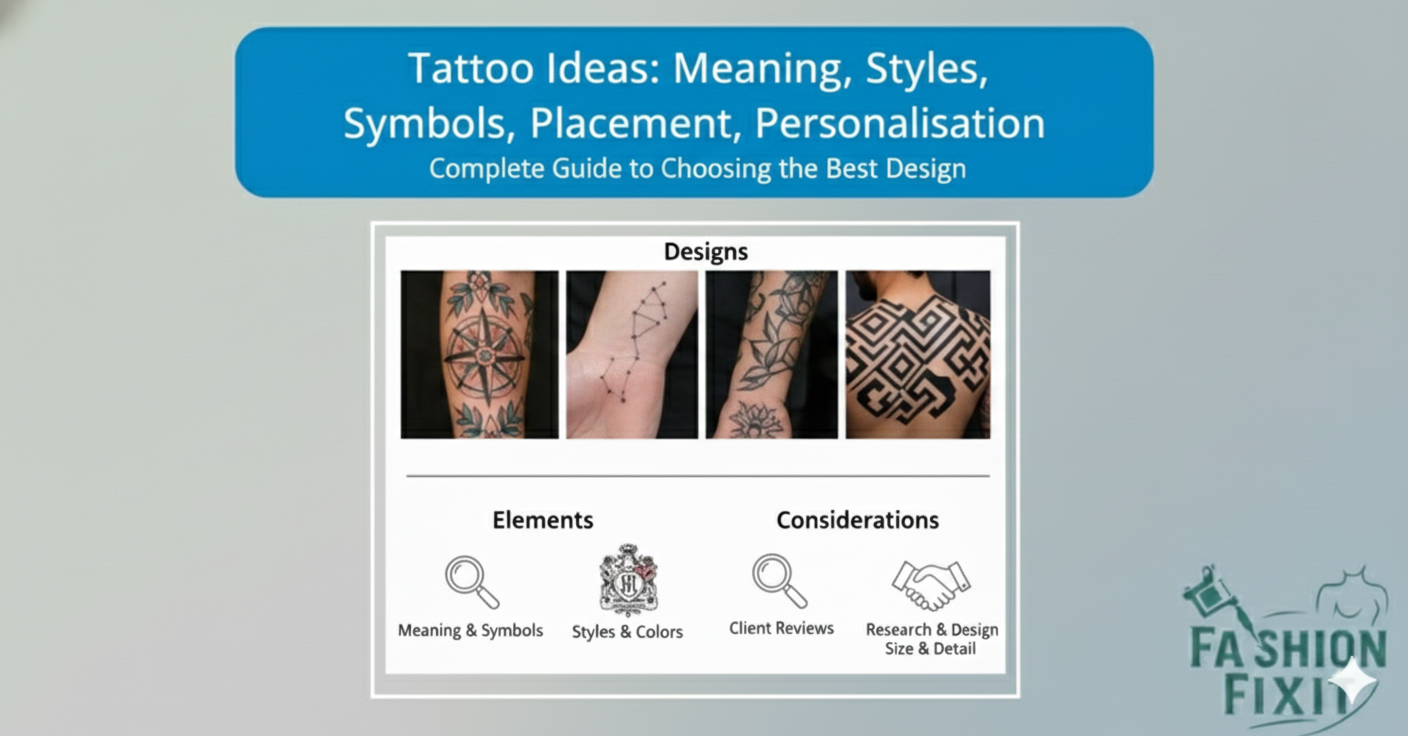
Tattoo ideas create structured systems that organise meaning, style, placement, ageing behaviour, and personalization into one coherent framework. Defined structure supports clarity, durability, and identity alignment during permanent body art planning.
Tattoo ideas use symbolic forms, spiritual motifs, memorial elements, heritage markers, transformation imagery, numerals, geometric structures, botanical forms, abstract patterns, minimalist shapes, and pop culture references to create a stable visual identity. Tattoo ideas adapt to themed categories, stylistic variations, and placement logic for arms, legs, back, chest, ribs, hands, fingers, and wrists through balanced composition.
Tattoo ideas strengthen relevance through personalised symbolism, narrative integration, stylistic adaptation, numeric representation, and heritage alignment. Tattoo ideas depend on accurate artist selection, ageing-focused design choices, preparation routines, aftercare structure, and long-term expansion planning for cohesive tattoo collections. Defined evaluation ensures tattoo ideas remain meaningful across present expression and future aesthetic development.
What Are Tattoo Ideas?
Tattoo ideas are structured design concepts that define style, meaning, composition, and symbolism for permanent body art. Structured design concepts create a single visual framework that organises motifs, colours, scales, and line density for coherent artwork.
Structured design concepts include geometric patterns, floral forms, animal symbols, celestial themes, lettering systems, abstract compositions, realism methods, and fine-line illustration. Structured design concepts align narrative meaning with visual structure through unified aesthetic planning and sequential design refinement.
Why Do Tattoo Ideas Matter When Choosing Body Art?
Tattoo ideas matter because structured design concepts create clear direction for style, meaning, and composition during body art planning. Structured design concepts define visual parameters that organise motifs, scales, colours, and symbolic elements for coherent artwork.
Visual Outcome Enhancement
Structured design concepts enhance visual outcomes through defined motifs, scales, and line structures. Defined visual parameters create balanced shapes, controlled shading, and consistent composition.
Meaning and Symbolism Organisation
Structured design concepts organise narrative meaning through structured symbolic elements. Structured symbolic elements connect memories, values, cultural references, and commemorative themes to precise visual forms.
Professional Execution Support
Structured design concepts support professional execution through guided preparation, stencil accuracy, and controlled shading sequences. Guided sequences reduce design errors and strengthen technical precision during the full creative process.
What Should You Consider Before Choosing a Tattoo Idea?
The essential factors before choosing a tattoo idea are meaning, style, placement, size, colour strategy, ageing behaviour, and artist alignment, because structured evaluation of these seven elements creates precise, durable, and personally relevant body art decisions. Tattoo ideas gain stability when each factor receives defined parameters, clear boundaries, and consistent visual logic.
Meaning and Personal Narrative in Tattoo Ideas
Meaning defines the narrative role of a tattoo idea within personal identity. Narrative role connects tattoo ideas to memories, values, life milestones, relationships, or belief systems. Clear meaning prevents impulsive selection and supports tattoo ideas that remain emotionally relevant across multiple life stages.
Style and Visual Language in Tattoo Ideas
Style determines the visual language that organises a tattoo idea. Visual language groups tattoo ideas into fine-line minimalism, traditional bold line work, realism, geometric patterning, illustrative composition, ornamental detailing, and script-based lettering. Consistent style selection prevents visual conflict when multiple tattoo ideas combine on the same body.
Body Placement and Anatomy for Tattoo Ideas
Body placement regulates how a tattoo idea interacts with anatomy, movement, and clothing coverage. Placement planning for tattoo ideas considers muscle lines, joint movement, skin curvature, and alignment with existing tattoos. Strategic mapping preserves readability of tattoo ideas from common viewing angles and typical standing or seated positions.
Size, Detail, and Complexity of Tattoo Ideas
Size determines how much detail a tattoo idea can support while remaining legible. Small tattoo ideas suit simple symbols, line icons, or minimal text, while complex scenes, portrait work, and dense patterning require larger surfaces. Proportional scaling prevents crowded lines and reduces risk of blurred elements as tattoo ideas age.
Colour Strategy and Ink Palette in Tattoo Ideas
Colour strategy defines whether a tattoo idea relies on blackwork, grayscale shading, or multi-colour ink palettes. Defined palettes for tattoo ideas manage contrast, tonal hierarchy, and saturation. High-contrast combinations preserve legibility, while softer gradients support atmospheric or delicate tattoo ideas without losing structural clarity.
Ageing Behaviour and Longevity of Tattoo Ideas
Ageing behaviour describes how a tattoo idea changes over years of wear, sun exposure, and skin texture variation. Tattoo ideas that use bold outlines, simplified shapes, and clear negative space retain structure more effectively than ultra-dense micro-line designs. Concentrated dark zones and controlled shading help tattoo ideas maintain coherence across decades.
Artist Alignment and Technical Execution of Tattoo Ideas
Artist alignment matches a tattoo idea with a specialist whose portfolio demonstrates the required technique. Portfolio review for tattoo ideas focuses on healed results, line consistency, smooth shading, colour packing, and composition balance. Accurate matching between tattoo ideas and artists reduces technical risk, supports clean healing, and delivers outcomes that reflect the original concept with high fidelity.
What Are the Most Popular Tattoo Ideas in the United States Right Now?
The most popular tattoo ideas in the United States right now reflect minimalism, symbolism, realism, and contemporary pattern work because these four design categories generate the highest request volume across national tattoo studios. Popularity increases when motifs combine clear meaning with stable visual structure.
Minimal Tattoo Ideas
Minimal tattoo ideas dominate national demand through simplified symbols and fine-line forms. Simplified symbols include hearts, stars, initials, micro-florals, and single-stroke icons. Structured minimalism produces clean line density and high readability.
Realism Tattoo Ideas
Realism tattoo ideas gain prominence through lifelike representation. Lifelike representation includes portrait work, animal depictions, botanical renderings, and detailed grayscale scenes. Controlled shading and proportional accuracy define realism quality.
Symbolic Tattoo Ideas
Symbolic tattoo ideas remain highly adopted because symbolic motifs communicate personal values. Symbolic motifs include zodiac signs, spiritual symbols, numerals, mythological figures, and heritage markers. Defined symbolism strengthens emotional relevance.
Botanical Tattoo Ideas
Botanical tattoo ideas remain consistently popular through structured organic forms. Structured organic forms include roses, peonies, vines, leaves, and wildflowers. Botanical designs support balanced composition and adaptable scaling.
Geometric Tattoo Ideas
Geometric tattoo ideas increase adoption through precise shape systems. Precise shape systems include mandalas, line grids, symmetry clusters, stacked triangles, and pattern loops. Mathematical clarity improves long-term structural stability.
Abstract Tattoo Ideas
Abstract tattoo ideas expand through expressive visual experimentation. Expressive forms include brush-stroke work, fragmented shapes, texture clusters, and non-literal compositions. Abstract arrangements provide unique identity markers.
Script Tattoo Ideas
Script tattoo ideas maintain strong demand through structured typography. Structured typography includes serif lettering, cursive lines, bold uppercase text, and numerically coded phrases. Script clarity depends on spacing and stroke weight.
Contemporary Fusion Tattoo Ideas
Contemporary fusion tattoo ideas rise through blended aesthetic systems. Blended systems combine realism with geometric framing, minimal icons with brush-strokes, or botanical forms with abstract shapes. Fusion structures diversify design outcomes while maintaining coherence.
Tattoo Ideas by Category
What Are the Best Small Tattoo Ideas?
The best small tattoo ideas are minimal symbols, micro-florals, micro-animals, miniature geometric forms, and short script lines because these five categories maintain clarity, balance, and long-term readability at reduced scale. Defined simplicity preserves structural stability within limited surface areas.
Minimal Symbol Tattoo Ideas
Minimal symbol tattoo ideas create strong visual impact through condensed form. Condensed form includes hearts, stars, crescent shapes, arrows, suns, and abstract icons. Clear line density maintains sharp definition during ageing.
Micro-Floral Tattoo Ideas
Micro-floral tattoo ideas gain popularity through organic balance. Organic balance includes single roses, sprigs, daisies, lavender stems, and tiny wildflowers. Simplified petals and controlled shading protect clarity within compact dimensions.
Micro-Animal Tattoo Ideas
Micro-animal tattoo ideas offer personal symbolism through small-scale representation. Small-scale representation includes birds, butterflies, bees, cats, and dogs. Defined silhouettes ensure recognisable shapes in reduced formats.
Miniature Geometric Tattoo Ideas
Miniature geometric tattoo ideas achieve precision through structured shape systems. Structured shape systems include triangles, diamonds, circles, grids, and mandala fragments. Mathematical alignment strengthens visual order.
Short Script Tattoo Ideas
Short script tattoo ideas communicate meaning through typography efficiency. Typography efficiency includes single words, initials, dates, and short phrases. Clean stroke weight preserves legibility across micro sizes.
Micro Icon Cluster Tattoo Ideas
Micro icon cluster tattoo ideas create narrative sets through multiple small motifs. Narrative sets include star clusters, botanical trios, abstract pairs, and symbolic sequences. Balanced spacing prevents crowding and maintains aesthetic harmony.
What Meaningful Tattoo Ideas Are Popular Today?
The meaningful tattoo ideas popular today include symbolic tattoos, memorial tattoos, spiritual tattoos, numeral tattoos, relationship tattoos, and transformation tattoos because structured meaning creates long-term emotional relevance in permanent body art. Defined meaning stabilises narrative continuity.
Symbolic Tattoos
Symbolic tattoos generate meaning through culturally recognised visual forms. Recognised forms include zodiac icons, mythological elements, protective symbols, and heritage markers. Symbolic clarity reinforces personal identity within a structured design framework.
Memorial Tattoos
Memorial tattoos preserve remembrance through personalised design components. Personalised components include dates, initials, handwriting samples, portrait outlines, and object-based representations. Defined memorial structure strengthens emotional permanence.
Spiritual Tattoos
Spiritual tattoos express belief systems through sacred visual structures. Sacred structures include mandalas, sacred geometry patterns, crosses, and meditative symbols. Structured spiritual imagery maintains thematic coherence and contemplative focus.
Numeral Tattoos
Numeral tattoos communicate significant life markers through structured numeric sequences. Numeric sequences include birthdates, anniversaries, milestone numbers, and coded identifiers. Precise alignment ensures clear hierarchy and long-term readability.
Relationship Tattoos
Relationship tattoos communicate connection through paired or complementary visual elements. Paired elements include linked initials, matched icons, complementary shapes, and dual symbolic forms. Balanced structure reinforces relational meaning.
Transformation Tattoos
Transformation tattoos represent stages of growth through metaphorical imagery. Metaphorical imagery includes butterflies, phoenix figures, blooming botanicals, and ascending line paths. Defined transformation motifs strengthen narratives of change and personal evolution.
What Unique Tattoo Ideas Can Help You Stand Out?
The unique tattoo ideas that help you stand out include abstract structures, fusion designs, optical patterns, personalised concepts, symbolic hybrids, and experimental line systems because these categories create uncommon visual identities and high differentiation. Defined originality strengthens aesthetic distinction.
Abstract Tattoos
Abstract tattoos generate uniqueness through non-literal visual expression. Non-literal expression includes fragmented shapes, brush-stroke textures, irregular gradients, and asymmetrical forms. Abstract structure promotes individuality through unrestricted composition.
Fusion Tattoos
Fusion tattoos stand out through combined aesthetic systems. Combined systems merge realism with geometric framing, fine-line detail with colour blocking, or botanical forms with abstract accents. Structured blending increases visual richness.
Optical Illusion Tattoos
Optical illusion tattoos create impact through depth effects and perceptual distortion. Depth effects include 3D shading, negative-space tricks, layered grids, and warped symmetry. Controlled contrast produces striking movement.
Personal Concept Tattoos
Personal concept tattoos create uniqueness through self-defined themes. Self-defined themes include custom symbols, autobiographical icons, personal maps, and narrative sequences built from individual experiences. Precise visual translation strengthens originality.
Hybrid Symbol Tattoos
Hybrid symbol tattoos generate distinction through combined symbolic elements. Combined elements include cultural icons mixed with numerals, mythological figures integrated with geometric shapes, or spiritual motifs paired with abstract lines. Structured hybridisation expands meaning.
Experimental Line Tattoos
Experimental line tattoos stand out through unconventional line behaviour. Unconventional behaviour includes broken-line structures, layered strokes, variable-width patterns, and kinetic line routes. Line experimentation enhances stylistic individuality.
What Are the Best Tattoo Ideas for Men?
The best tattoo ideas for men include geometric structures, realism motifs, symbolic forms, script elements, abstract patterns, and strength-focused imagery because these six categories align with common thematic preferences and strong visual frameworks. Defined structure strengthens clarity and long-term aesthetic stability.
Geometric Tattoos
Geometric tattoos offer precision through mathematical shape systems. Shape systems include mandalas, symmetry clusters, line grids, triangles, and stacked polygons. Clear geometry supports bold structure.
Realism Tattoos
Realism tattoos create impact through lifelike representation. Lifelike motifs include portrait outlines, animal figures, mechanical elements, and detailed nature scenes. Controlled shading ensures dimensional accuracy.
Symbolic Tattoos
Symbolic tattoos convey meaning through recognisable cultural forms. Recognisable forms include mythological figures, spiritual icons, zodiac signs, and heritage symbols. Defined symbolism reinforces personal identity.
Script Tattoos
Script tattoos communicate significance through structured typography. Structured typography includes dates, initials, meaningful words, and short phrases. Consistent spacing strengthens legibility.
Abstract Tattoos
Abstract tattoos provide individuality through expressive composition. Expressive composition includes brush-stroke patterns, fragmented shapes, gradients, and non-literal structures. Creative abstraction enhances uniqueness.
Strength-Themed Tattoos
Strength-themed tattoos emphasise resilience through symbolic imagery. Symbolic imagery includes lions, eagles, wolves, mountains, and armour-inspired motifs. Defined representation reinforces themes of power and determination.
What Gender-Neutral Tattoo Ideas Are Great for All Styles?
The gender-neutral tattoo ideas great for all styles include geometric forms, botanical elements, abstract patterns, symbolic icons, minimalist structures, and celestial motifs because these six categories maintain universal visual balance and broad aesthetic adaptability. Defined neutrality supports wide cultural and stylistic relevance.
Geometric Tattoos
Geometric tattoos achieve universality through mathematical clarity. Mathematical clarity includes triangles, circles, line grids, symmetry clusters, and structured mandala fragments. Balanced geometry suits varied artistic preferences.
Botanical Tattoos
Botanical tattoos create neutrality through natural form. Natural form includes leaves, stems, branches, vines, and simplified floral shapes. Organic structure adapts to minimal, bold, or illustrative styles.
Abstract Tattoos
Abstract tattoos provide inclusivity through non-literal shape language. Shape language includes gradients, fragmented forms, brush-stroke patterns, and atmospheric textures. Open interpretation supports diverse identities.
Symbolic Tattoos
Symbolic tattoos maintain universality through shared cultural imagery. Cultural imagery includes anchors, arrows, infinity signs, protective symbols, and directional icons. Defined symbolism strengthens narrative flexibility.
Minimalist Tattoos
Minimalist tattoos deliver neutrality through reduced line density. Reduced density includes micro-icons, single-stroke shapes, compact outlines, and simplified motifs. Minimal structure complements multiple aesthetic tastes.
Celestial Tattoos
Celestial tattoos support broad appeal through cosmic themes. Cosmic themes include stars, moons, planetary symbols, orbits, and constellation fragments. Structured celestial imagery expresses meaning without gendered associations.
Tattoo Ideas by Theme
What Are the Best Nature-Inspired Tattoo Ideas?
The best nature-inspired tattoo ideas include botanical motifs, animal figures, landscape elements, celestial forms, and natural texture patterns because these five categories provide structured symbolism and balanced organic composition. Defined natural themes create clear visual identity in permanent body art.
Botanical Tattoos
Botanical tattoos generate harmony through structured organic shapes. Structured shapes include roses, peonies, ferns, vines, leaves, lavender stems, and wildflower clusters. Controlled petal outlines and balanced shading improve long-term clarity.
Animal Tattoos
Animal tattoos communicate symbolic meaning through recognisable natural forms. Recognisable forms include birds, butterflies, wolves, tigers, foxes, and marine species. Defined silhouettes and proportional detail strengthen representation.
Landscape Tattoos
Landscape tattoos express natural environments through layered composition. Layered composition includes mountains, forests, waves, desert scenes, and horizon lines. Clear foreground–background separation enhances depth.
Celestial Tattoos
Celestial tattoos represent natural cycles through cosmic motifs. Cosmic motifs include moons, stars, suns, planetary orbits, and constellation fragments. Structured geometric alignment supports symbolic precision.
Natural Texture Tattoos
Natural texture tattoos create uniqueness through pattern-based interpretation. Pattern-based interpretation includes wood grain lines, stone textures, wave curves, cloud gradients, and feather patterns. Consistent line rhythm reinforces organic authenticity.
What Spiritual or Symbolic Tattoo Ideas Are Popular?
The spiritual or symbolic tattoo ideas popular today include sacred geometry, protective symbols, mythological figures, celestial icons, and numerological markers because these five categories organise belief, identity, and meaning through defined visual structures. Structured symbolism strengthens narrative continuity.
Sacred Geometry Tattoos
Sacred geometry tattoos express spiritual structure through mathematical precision. Mathematical precision includes mandalas, seed-of-life patterns, flower-of-life forms, and symmetry clusters. Defined geometry reflects balance, harmony, and interconnectedness.
Protective Symbol Tattoos
Protective symbol tattoos convey spiritual safeguarding through culturally recognised icons. Recognised icons include the hamsa, evil eye, ankh, yin–yang, and triquetra. Clear symbolic form reinforces themes of protection and strength.
Mythological Tattoos
Mythological tattoos generate meaning through narrative-based figures. Narrative figures include phoenix forms, dragons, Greek deities, Norse symbols, and ancestral cultural emblems. Structured mythology connects personal identity with long-standing storytelling traditions.
Celestial Tattoos
Celestial tattoos represent spiritual cycles through cosmic imagery. Cosmic imagery includes moons, stars, suns, planetary sequences, and constellation fragments. Defined celestial alignment communicates guidance, intuition, and transformation.
Numerological Tattoos
Numerological tattoos convey spiritual significance through structured numeric sequences. Structured sequences include life-path numbers, angel numbers, repeated digit patterns, and coded symbolic dates. Precise arrangement strengthens interpretive clarity.
Symbol–Text Combination Tattoos
Symbol–text combination tattoos enhance meaning through paired visual and linguistic elements. Paired elements include sacred icons with short phrases, ritual symbols with initials, and spiritual motifs with coded words. Balanced integration reinforces depth and intentionality.
What Minimalist Tattoo Ideas Are Trending in the U.S.?
The minimalist tattoo ideas trending in the United States include micro-symbols, fine-line botanicals, geometric forms, micro-script designs, and simplified silhouettes because these five categories maintain clarity, balance, and precision at reduced scale. Defined minimal structure supports long-term readability.
Micro-Symbol Tattoos
Micro-symbol tattoos achieve impact through condensed form. Condensed form includes hearts, stars, arrows, dots, crescents, and abstract icons. Clean stroke weight preserves sharp definition during ageing.
Fine-Line Botanical Tattoos
Fine-line botanical tattoos create softness through organic micro-detail. Organic micro-detail includes single leaves, stems, lavender sprigs, daisies, and minimal floral outlines. Controlled shading maintains clarity at small dimensions.
Geometric Minimal Tattoos
Geometric minimal tattoos provide structure through mathematical simplicity. Mathematical simplicity includes triangles, circles, diamonds, symmetry clusters, and linear grids. Defined geometry strengthens visual order.
Micro-Script Tattoos
Micro-script tattoos communicate meaning through refined typography. Refined typography includes initials, single words, short phrases, and numeric sequences. Tight spacing ensures long-term legibility.
Simplified Silhouette Tattoos
Simplified silhouette tattoos express form through reduced outlines. Reduced outlines include animal silhouettes, human outlines, celestial shapes, and landscape micro-contours. Minimal contouring supports crisp interpretation.
What Artistic and Creative Tattoo Ideas Should You Consider?
The artistic and creative tattoo ideas to consider include abstract compositions, illustrative concepts, surreal hybrids, geometric-art fusions, experimental line work, and texture-driven designs because these six categories create strong visual distinction and conceptual depth. Defined creativity strengthens originality in permanent body art.
Abstract Art Tattoos
Abstract art tattoos generate creativity through non-literal visual language. Non-literal language includes fragmented shapes, gradient washes, brush-stroke patterns, and asymmetric forms. Abstract structure supports open interpretation.
Illustrative Art Tattoos
Illustrative art tattoos deliver artistic richness through detailed storytelling. Detailed storytelling includes character forms, narrative scenes, stylised objects, and comic-inspired elements. Defined illustration enhances visual clarity.
Surreal Hybrid Tattoos
Surreal hybrid tattoos create uniqueness through unexpected visual combinations. Unexpected combinations include animal–object merges, botanical–mechanical blends, dreamlike distortions, and symbolic fusions. Surreal structure expands conceptual meaning.
Geometric-Art Fusion Tattoos
Geometric-art fusion tattoos achieve creativity through combined mathematical and illustrative systems. Combined systems include mandala fragments overlaid with realism, geometric framing around portraits, and structured symmetry supporting organic shapes. Balanced fusion enhances visual harmony.
Experimental Line Tattoos
Experimental line tattoos express creativity through unconventional line behaviour. Unconventional behaviour includes layered strokes, broken-line paths, variable-width routing, and kinetic line flow. Dynamic line systems strengthen stylistic individuality.
Texture-Driven Tattoos
Texture-driven tattoos add artistic depth through pattern replication. Pattern replication includes wood grain effects, stone textures, textile patterns, wave lines, and cloud gradients. Defined texture increases tactile visual impact.
What Pop Culture Tattoo Ideas Are Trending?
The pop culture tattoo ideas trending today include film motifs, television references, music symbols, gaming icons, nostalgic visuals, and hybrid reinterpretations because these six categories organise contemporary cultural identity into defined visual forms. Structured cultural motifs strengthen narrative relevance in tattoo design.
Film Tattoos
Film tattoos gain popularity through iconic cinematic symbolism. Cinematic symbolism includes character outlines, emblematic objects, thematic silhouettes, and stylised scene fragments. Defined film imagery reinforces recognition and storytelling.
Television Tattoos
Television tattoos trend through series-based visual identity. Series-based identity includes logos, symbolic props, memorable quotes, and character silhouettes. Structured references maintain clarity for long-term fans.
Music Tattoos
Music tattoos express cultural influence through symbolic audio markers. Symbolic markers include lyric fragments, album iconography, instrument outlines, and artist-related symbols. Defined music elements support emotional association.
Gaming Tattoos
Gaming tattoos expand through interactive world symbolism. Interactive symbolism includes pixel icons, faction emblems, character outlines, and minimal environment motifs. Clear graphic language supports recognisability across gaming communities.
Nostalgia Tattoos
Nostalgia tattoos trend through generational cultural memory. Generational memory includes retro cartoon forms, vintage graphic shapes, classic film symbols, and 80s–90s design elements. Defined nostalgia strengthens personal connection.
Hybrid Pop Culture Tattoos
Hybrid pop culture tattoos stand out through combined cultural frameworks. Combined frameworks include merged characters, blended symbols, stylised reinterpretations, and thematic fusion scenes. Structured hybridisation increases creative depth.
What Travel-Inspired Tattoo Ideas Capture Your Adventures?
The travel-inspired tattoo ideas that capture adventures include map motifs, landmark symbols, coordinate designs, cultural icons, transit elements, and nature-journey imagery because these six categories translate movement, memory, and exploration into defined visual forms. Structured travel symbolism preserves experiential meaning.
Map Tattoos
Map tattoos represent exploration through geographic outlines and directional forms. Geographic forms include continents, countries, regions, and stylised world maps. Clear line structure supports recognisable cartographic identity.
Landmark Tattoos
Landmark tattoos convey travel memory through iconic architectural silhouettes. Architectural silhouettes include towers, bridges, temples, statues, and skyline fragments. Defined landmark shapes strengthen narrative precision.
Coordinate Tattoos
Coordinate tattoos preserve location significance through numeric reference systems. Numeric systems include latitude–longitude pairs marking cities, milestones, or meaningful destinations. Precise formatting ensures long-term clarity.
Cultural Symbol Tattoos
Cultural symbol tattoos reflect global experience through regional iconography. Regional iconography includes traditional motifs, heritage symbols, festival elements, and language-based markers. Structured cultural forms communicate respectful representation.
Transit Tattoos
Transit tattoos represent journey structure through movement-related visuals. Movement visuals include airplanes, compasses, passports, route lines, and minimal vehicle silhouettes. Defined transit imagery emphasises exploration.
Nature-Journey Tattoos
Nature-journey tattoos express adventure through environmental motifs. Environmental motifs include mountains, waves, forests, deserts, and horizon lines. Clear natural forms evoke themes of discovery and personal growth.
Tattoo Ideas by Placement
What Are the Best Tattoo Ideas for the Arm?
The best tattoo ideas for the arm include sleeve compositions, band structures, vertical motifs, panel-style segments, fine-line icons, and geometric frameworks because these six categories utilise the arm’s elongated surface and curved anatomy for structured visual flow. Defined placement strengthens clarity and balance.
Sleeve Tattoo Ideas
Sleeve tattoo ideas create continuous narrative structure across the full arm. Continuous structure includes themed scenes, botanical expansions, cultural symbolism, geometric progressions, and illustrative storylines. Layered composition enhances depth.
Band Tattoo Ideas
Band tattoo ideas achieve symmetry through wrapped linear design. Wrapped design includes solid bands, patterned bands, tribal-inspired sequences, and geometric wraps. Consistent width maintains structural harmony.
Vertical Tattoo Ideas
Vertical tattoo ideas use the arm’s length to organise linear motifs. Linear motifs include vines, script lines, celestial sequences, arrows, and elongated symbols. Vertical flow strengthens visual direction.
Panel Tattoo Ideas
Panel tattoo ideas segment the arm into structured design zones. Structured zones include rectangular panels, curved dividers, abstract blocks, and illustrative compartments. Clear segmentation supports diverse motifs without visual conflict.
Fine-Line Arm Tattoos
Fine-line arm tattoos provide minimal structure through delicate outlines. Delicate outlines include micro-florals, small icons, minimal shapes, and compact symbols. Controlled stroke weight maintains precision.
Geometric Arm Tattoos
Geometric arm tattoos emphasise form through mathematical alignment. Mathematical alignment includes mandalas, symmetry clusters, stacked shapes, and line grids. Defined geometry enhances visual order along the arm’s contours.
What Leg Tattoo Ideas Work Best?
The leg tattoo ideas that work best include vertical motifs, wrap bands, panel structures, large illustrative compositions, geometric frameworks, and fine-line elements because these six categories align with the leg’s elongated shape and broad surface geometry. Defined placement strengthens flow and proportional balance.
Vertical Leg Tattoos
Vertical leg tattoos maximise length through structured linear design. Structured linear design includes vines, arrows, script lines, botanical climbs, and stacked symbolic forms. Vertical orientation enhances direction and visual continuity.
Leg Band Tattoos
Leg band tattoos create symmetry through wrapped horizontal structure. Wrapped horizontal structure includes solid bands, patterned bands, tribal-inspired sequences, and geometric repeats. Consistent band width preserves harmony around the leg.
Panel-Style Leg Tattoos
Panel-style leg tattoos divide the leg into balanced composition zones. Balanced zones include rectangular segments, curved dividers, abstract blocks, and illustrative compartments. Clear segmentation allows multiple motifs without visual conflict.
Large Illustrative Leg Tattoos
Large illustrative leg tattoos use broad space for detailed narrative imagery. Detailed imagery includes animals, botanical scenes, mythological figures, and landscape compositions. Expanded surface area supports depth and shading.
Geometric Leg Tattoos
Geometric leg tattoos highlight structure through mathematical alignment. Mathematical alignment includes mandalas, symmetry clusters, stacked polygons, and line-grid systems. Defined precision enhances flow along the leg’s contours.
Fine-Line Leg Tattoos
Fine-line leg tattoos provide subtle expression through minimal detail. Minimal detail includes micro-icons, small florals, simple shapes, and delicate symbolic elements. Controlled stroke weight maintains clarity at smaller scales.
What Back Tattoo Ideas Are Most Popular?
The back tattoo ideas most popular today include large illustrative scenes, symmetrical compositions, botanical expansions, symbolic frameworks, geometric structures, and fine-line arrangements because these six categories utilise the back’s wide surface for balanced visual impact. Defined spatial planning strengthens clarity and depth.
Large Illustrative Back Tattoos
Large illustrative back tattoos gain popularity through expansive narrative space. Expansive narratives include animals, mythological figures, landscape scenes, and portrait compositions. Broad coverage supports detailed shading and layered storytelling.
Symmetrical Back Tattoos
Symmetrical back tattoos create balance through mirrored structural design. Mirrored structures include mandalas, wing forms, ornamental patterns, and dual-side symbolic elements. Symmetry enhances visual stability across the spine line.
Botanical Back Tattoos
Botanical back tattoos remain highly adopted through organic structural flow. Organic flow includes roses, peonies, vines, branches, and large floral clusters. Extended curvature supports natural movement in botanical compositions.
Symbolic Back Tattoos
Symbolic back tattoos maintain popularity through culturally meaningful imagery. Meaningful imagery includes sacred symbols, numerals, heraldic icons, and spiritual motifs. Defined symbolism provides narrative focus across a wide canvas.
Geometric Back Tattoos
Geometric back tattoos attract attention through mathematical precision. Mathematical precision includes mandalas, structured grids, symmetry clusters, and shape progressions. Clear geometry aligns effectively with the spine and shoulder contours.
Fine-Line Back Tattoos
Fine-line back tattoos offer subtle impact through delicate detailing. Delicate detailing includes minimal figures, micro florals, abstract line paths, and lightweight symbolic forms. Controlled stroke density maintains refined aesthetics across large areas.
What Are the Best Chest and Rib Tattoo Ideas?
The best chest and rib tattoo ideas include symmetrical motifs, flowing organic forms, symbolic structures, script elements, geometric frameworks, and illustrative compositions because these six categories complement the curved anatomy and dynamic movement of the chest–rib area. Defined placement strengthens contour harmony.
Symmetrical Chest Tattoos
Symmetrical chest tattoos create balanced visual structure through mirrored design. Mirrored design includes mandalas, wing forms, ornamental clusters, and dual symbolic elements. Symmetry aligns naturally with the sternum and collarbone contours.
Flowing Rib Tattoos
Flowing rib tattoos use elongated curvature to support organic movement. Organic movement includes vines, branches, botanical climbs, feather forms, and fluid abstract lines. Extended vertical orientation enhances anatomical flow.
Symbolic Chest and Rib Tattoos
Symbolic chest and rib tattoos emphasise meaning through clear visual identity. Visual identity includes sacred icons, numerals, heritage markers, protective symbols, and spiritual motifs. Defined symbolism maintains narrative strength.
Script Tattoos for Chest and Ribs
Script tattoos on the chest and ribs communicate meaning through refined typography. Refined typography includes single words, short phrases, initials, and date formats. Controlled spacing preserves legibility across curved surfaces.
Geometric Chest and Rib Tattoos
Geometric tattoos in the chest–rib region achieve structure through mathematical alignment. Mathematical alignment includes mandalas, symmetry clusters, angled forms, and line-grid systems. Clear geometry reinforces shape coherence.
Illustrative Chest and Rib Tattoos
Illustrative tattoos on the chest and ribs provide narrative depth through detailed imagery. Detailed imagery includes animals, mythological figures, botanical arrangements, and conceptual scenes. Broad curvature supports layered shading and visual storytelling.
What Hand, Finger, and Wrist Tattoo Ideas Should You Consider?
The hand, finger, and wrist tattoo ideas to consider include minimal symbols, fine-line patterns, micro-script elements, geometric forms, botanical accents, and small illustrative motifs because these six categories maintain clarity within limited surface areas. Defined simplicity preserves detail at small scale.
Minimal Symbol Tattoos
Minimal symbol tattoos suit hands, fingers, and wrists through compact visual structure. Compact structure includes hearts, stars, arrows, dots, crescents, and abstract icons. Clean contours protect long-term readability.
Fine-Line Pattern Tattoos
Fine-line pattern tattoos enhance small areas through delicate repetition. Delicate repetition includes micro-mandalas, line clusters, symmetry fragments, and small ornamental patterns. Controlled line density prevents overcrowding.
Micro-Script Tattoos
Micro-script tattoos communicate meaning through refined typography. Refined typography includes initials, single words, short phrases, and numeric markers. Tight spacing supports clarity on narrow surfaces.
Geometric Tattoos
Geometric tattoos provide structured form through simple mathematical shapes. Simple shapes include triangles, diamonds, circles, and angle-based grids. Defined geometry adapts well to small curved surfaces.
Botanical Tattoos
Botanical tattoos add softness through micro-organic forms. Micro-organic forms include leaves, stems, sprigs, and small floral outlines. Light shading maintains balance without overwhelming the area.
Small Illustrative Tattoos
Small illustrative tattoos create character through simplified detail. Simplified detail includes miniature animals, tiny landscapes, object icons, and symbolic figures. Reduced complexity ensures visual precision.
What Tattoo Ideas Are Appropriate for Different Age Groups?
The tattoo ideas appropriate for different age groups include symbolic designs, minimalist forms, narrative motifs, legacy markers, and refined illustrative concepts because these five categories align with evolving identity, stability, and aesthetic preference across life stages. Defined age alignment strengthens long-term relevance.
Tattoo Ideas for Teens (18–19)
Tattoo ideas for teens prioritise simplicity through minimal and symbolic forms. Minimal and symbolic forms include micro-icons, initials, zodiac motifs, small florals, numerals, and compact geometric shapes. Reduced complexity supports early-stage identity development.
Tattoo Ideas for Young Adults (20s)
Tattoo ideas for young adults emphasise exploration through expressive themes. Expressive themes include abstract patterns, fine-line botanicals, travel symbols, pop culture references, and conceptual illustrative motifs. Structured exploration reflects expanding personal narrative.
Tattoo Ideas for Adults (30s)
Tattoo ideas for adults highlight meaning through stable symbolic structures. Stable structures include heritage icons, family numerals, botanical compositions, geometric frameworks, and balanced script elements. Defined symbolism supports mature identity expression.
Tattoo Ideas for Midlife (40s)
Tattoo ideas for midlife focus on refinement through intentional visual design. Intentional design includes minimalist expansions, detailed florals, spiritual motifs, geometric precision, and commemorative elements. Refined structure reinforces long-term significance.
Tattoo Ideas for Later Life (50s and above)
Tattoo ideas for later life emphasise legacy through enduring visual clarity. Enduring clarity includes meaningful symbols, nature-inspired motifs, simplified illustrative scenes, honour-based numerals, and spiritual emblems. Defined simplicity maintains lasting readability.
Cross-Age Universal Tattoo Ideas
Cross-age universal tattoo ideas remain suitable for all groups through timeless visual logic. Timeless logic includes botanical forms, geometric lines, symbolic icons, minimalist shapes, and script markers. Stable composition supports ageless relevance.
What Tattoo Symbols Carry Deep Personal Meaning?
The tattoo symbols that carry deep personal meaning include spiritual icons, protective emblems, transformation markers, heritage symbols, commemorative numerals, and universal nature motifs because these six categories organise identity, memory, and belief within defined visual structures. Structured symbolism preserves long-term emotional relevance.
Spiritual Symbols
Spiritual symbols communicate belief through sacred visual language. Sacred language includes mandalas, crosses, om markings, sacred geometry clusters, and meditative line systems. Clear spiritual imagery reinforces inner values.
Protective Symbols
Protective symbols express safeguarding through culturally recognised forms. Recognised forms include the hamsa, evil eye, ankh, triquetra, and yin–yang. Defined protection motifs strengthen psychological grounding.
Transformation Symbols
Transformation symbols represent growth through metaphorical imagery. Metaphorical imagery includes butterflies, phoenix forms, blooming botanicals, ascending line paths, and chrysalis shapes. Clear transformation structure supports narratives of change.
Heritage Symbols
Heritage symbols convey ancestry through cultural iconography. Cultural iconography includes clan marks, national emblems, traditional patterns, mythological figures, and regional motifs. Defined heritage visuals reinforce identity continuity.
Commemorative Numerals
Commemorative numerals preserve memory through structured numeric sequences. Structured sequences include birthdates, anniversary dates, milestone numbers, and coded personal markers. Precision enhances symbolic clarity.
Universal Nature Symbols
Universal nature symbols express meaning through elemental forms. Elemental forms include mountains, waves, suns, moons, trees, and constellations. Defined natural imagery reflects stability, resilience, and renewal.
How Can You Personalize a Tattoo Idea to Make It More Meaningful?
The ways to personalize a tattoo idea include symbolic selection, narrative integration, stylistic adaptation, numeric representation, illustrative customization, and cultural alignment because these six methods create defined personal relevance within permanent body art. Structured personalization strengthens emotional depth and conceptual clarity.
Symbolic Selection
Symbolic selection personalizes a tattoo idea through deliberate icon choice. Deliberate icons include spiritual marks, protective emblems, transformation symbols, heritage motifs, and natural elements. Defined symbolism anchors meaning to identity.
Narrative Integration
Narrative integration personalizes a tattoo idea through story-based components. Story-based components include objects from significant memories, visual metaphors tied to life events, and motifs representing achievements or transitions. Structured narrative design preserves experiential detail.
Stylistic Adaptation
Stylistic adaptation personalizes a tattoo idea through tailored visual language. Tailored language includes minimal, geometric, illustrative, abstract, realism, or fine-line approaches matched to personal aesthetic preference. Consistent stylistic framing reinforces individuality.
Numeric Representation
Numeric representation personalizes a tattoo idea through coded numerical elements. Coded elements include birthdates, coordinates, anniversary numbers, life-path digits, and personal sequences. Precise formatting enhances interpretive accuracy.
Illustrative Customization
Illustrative customization personalizes a tattoo idea through artist-specific reinterpretation. Reinterpretation includes hand-drawn variations, custom line work, unique shading structures, and bespoke compositions. Defined artistic adaptation increases originality.
Cultural Alignment
Cultural alignment personalizes a tattoo idea through respectful incorporation of heritage-based symbols. Heritage-based symbols include traditional patterns, ancestral motifs, language elements, and region-specific emblems. Structured cultural context strengthens authenticity and meaning.
How Do You Choose the Right Tattoo Artist for Your Idea?
The right tattoo artist is chosen through portfolio analysis, style matching, technical evaluation, hygiene verification, communication clarity, and review assessment because these six criteria ensure accurate translation of a tattoo idea into high-quality permanent work. Defined selection improves outcome reliability.
Portfolio Analysis
Portfolio analysis identifies whether an artist’s previous work aligns with the visual structure of a tattoo idea. Relevant indicators include line precision, shading control, colour consistency, healed results, and composition balance. Clear stylistic evidence confirms capability.
Style Matching
Style matching selects an artist whose primary technique matches the intended concept. Style categories include fine-line, realism, geometric, traditional, illustrative, abstract, and ornamental. Defined stylistic alignment reduces design distortion.
Technical Evaluation
Technical evaluation measures craftsmanship required for a tattoo idea. Craftsmanship indicators include needle control, gradient smoothness, saturation density, symmetry accuracy, and detail retention. Strong technical markers demonstrate proficiency.
Hygiene Verification
Hygiene verification ensures safe execution through professional standards. Standards include sterilised equipment, single-use needles, clean workstations, documented sanitation processes, and licensed operation. Defined hygiene safeguards long-term health.
Communication Clarity
Communication clarity confirms that an artist understands the conceptual structure of a tattoo idea. Conceptual structure includes symbolism, style, size, placement, shading expectations, and line-density requirements. Clear dialogue reduces misalignment.
Review Assessment
Review assessment provides insight through community feedback. Feedback analysis includes client experiences, healed tattoo photos, service consistency, and satisfaction indicators. Structured review patterns reinforce trustworthiness.
How Can You Turn Your Tattoo Idea Into a Full Tattoo Collection?
A tattoo idea becomes a full tattoo collection through theme selection, visual framework creation, motif sequencing, stylistic continuity, spatial mapping, and long-term expansion planning because these six processes organise multiple designs into one coherent body-art system. Defined collection structure strengthens unity and narrative flow.
Theme Selection
Theme selection establishes the central concept that guides every tattoo in the collection. Central concepts include nature, geometry, mythology, spirituality, travel, identity narratives, or symbolic sequences. Defined thematic focus prevents fragmentation across multiple designs.
Visual Framework Creation
Visual framework creation builds the structural rules for a tattoo collection. Structural rules include line density, shading type, colour strategy, geometric ratios, and motif complexity levels. Consistent framework parameters maintain cohesion.
Motif Sequencing
Motif sequencing organises individual tattoos into an ordered conceptual progression. Ordered progression includes symbolic evolution, narrative chapters, botanical growth stages, geometric expansions, or numerological sequences. Defined sequencing reinforces storyline clarity.
Stylistic Continuity
Stylistic continuity unifies a tattoo collection through shared artistic language. Artistic language includes fine-line technique, realism detail, illustrative shading, abstract patterning, or minimal contour structure. Consistent style prevents visual conflict.
Spatial Mapping
Spatial mapping places each tattoo within a planned body layout. Body layout planning includes limb symmetry, torso alignment, negative-space distribution, and flow pathways between tattoos. Defined placement strategy creates natural movement across the collection.
Long-Term Expansion Planning
Long-term expansion planning anticipates future additions within the established system. Future planning includes motif variants, complementary symbols, extended scenes, and structural expansions. Predictive design ensures the collection grows without losing coherence.
How Do You Make Sure Your Tattoo Idea Will Age Well?
A tattoo idea ages well through line-density control, shading stability, colour planning, placement strategy, motif simplicity, and aftercare structure because these six factors determine long-term clarity, contrast, and structural preservation. Defined ageing principles strengthen durability over decades.
Line-Density Control
Line-density control protects long-term sharpness through balanced stroke weight. Balanced stroke weight avoids excessively thin micro-lines or overcrowded clusters. Defined spacing reduces risk of blurring as skin texture changes.
Shading Stability
Shading stability improves ageing through controlled gradient distribution. Controlled gradients use smooth transitions, restrained dark zones, and consistent tonal structure. Stable shading maintains readable form over time.
Colour Planning
Colour planning enhances longevity through selective palette management. Selective palettes favour saturated blacks, muted tones, and balanced contrast while avoiding rapid-fade pigments. Defined colour hierarchy preserves visual strength.
Placement Strategy
Placement strategy supports ageing through anatomically stable locations. Stable regions show slower distortion and reduced friction compared to high-movement or high-exposure areas. Defined placements protect structure.
Motif Simplicity
Motif simplicity increases durability through reduced complexity. Reduced complexity avoids hyper-dense details, micro-text blocks, and intricate miniature patterns. Clear shapes retain recognisable form during natural ageing.
Aftercare Structure
Aftercare structure maintains tattoo longevity through consistent healing management. Healing management includes moisturisation routines, sun-exposure reduction, cleansing discipline, and long-term SPF use. Defined aftercare safeguards ink integrity.
How Should You Prepare for a Tattoo Appointment?
Preparation for a tattoo appointment requires hydration, nutrition, skin readiness, health management, design confirmation, and logistical planning because these six steps create stable physical conditions and clear procedural alignment for successful tattoo execution. Defined preparation strengthens comfort, accuracy, and healing quality.
Hydration Preparation
Hydration preparation stabilises skin elasticity through consistent water intake. Stable elasticity improves ink absorption and reduces irritation during the session. Maintaining hydration for 24–48 hours before the appointment enhances skin resilience.
Nutrition Preparation
Nutrition preparation supports endurance through balanced pre-session meals. Balanced intake includes complex carbohydrates, moderate protein, and low-sugar options. Defined nutrition prevents dizziness and maintains steady energy.
Skin Readiness
Skin readiness improves tattoo quality through surface conditioning. Conditioning includes moisturising the area for several days, avoiding sunburn, reducing dryness, and eliminating abrasive exfoliation. Prepared skin supports smooth line work.
Health Management
Health management protects safety through controlled physiological conditions. Controlled conditions include adequate sleep, reduced alcohol, elimination of blood-thinning substances, and monitoring of any temporary illness. Stable health improves pain tolerance and healing.
Design Confirmation
Design confirmation ensures procedural clarity through finalised visual structure. Visual structure includes size, placement, line density, shading approach, and colour decisions. Confirmed design reduces miscommunication with the artist.
Logistical Planning
Logistical planning improves appointment flow through structured organisation. Organisation includes wearing comfortable clothing, bringing identification, arranging transportation, managing time buffers, and preparing aftercare supplies. Defined logistics support an efficient session.
How Do You Care for a Tattoo After Getting It?
Tattoo aftercare requires cleansing structure, moisture regulation, protection management, irritation control, and long-term maintenance because these five processes preserve clarity, colour stability, and line integrity during healing. Defined aftercare prevents infection and strengthens long-term durability.
Cleansing Structure
Cleansing structure maintains hygiene through controlled washing routines. Controlled routines include gentle antibacterial cleansing, lukewarm water use, and avoidance of abrasive pressure. Structured cleansing removes surface bacteria without disrupting fresh ink.
Moisture Regulation
Moisture regulation supports healing through balanced hydration. Balanced hydration uses thin layers of recommended ointments, non-fragrant moisturisers, and timed application intervals. Regulated moisture prevents cracking and excessive scabbing.
Protection Management
Protection management preserves tattoo integrity through environmental shielding. Environmental shielding includes avoiding sun exposure, preventing friction from clothing, eliminating swimming, and reducing contact with contaminated surfaces. Defined protection safeguards vulnerable skin.
Irritation Control
Irritation control stabilises healing through monitored behavioural habits. Monitored habits include avoiding scratching, preventing picking, reducing impact against surfaces, and maintaining clean bedding. Structured irritation control limits damage to healing tissue.
Long-Term Maintenance
Long-term maintenance sustains tattoo quality through ongoing care practices. Ongoing practices include consistent moisturising, application of high-SPF sunscreen, and avoidance of long-term abrasive exposure. Defined maintenance preserves ink vibrancy and structural clarity.
What Common Tattoo Mistakes Should You Avoid?
The common tattoo mistakes to avoid include unclear concept planning, poor artist selection, incorrect sizing, unsuitable placement, neglectful aftercare, and impulsive decision-making because these six errors weaken design quality, longevity, and personal relevance. Defined avoidance improves long-term satisfaction.
Unclear Concept Planning
Unclear concept planning reduces visual coherence through undefined symbolism and inconsistent style. Undefined structure creates conflicting motifs and unstable composition. Clear conceptual framework prevents design fragmentation.
Poor Artist Selection
Poor artist selection increases technical risk through mismatched skill and style. Mismatched skill includes inconsistent line work, weak shading control, and inadequate portfolio evidence. Defined artist evaluation strengthens execution accuracy.
Incorrect Sizing
Incorrect sizing disrupts clarity through insufficient space for details or excessive scale. Insufficient space compresses motifs; excessive scale reduces harmony with anatomy. Precise dimensional planning preserves readability.
Unsuitable Placement
Unsuitable placement affects ageing and visibility through unstable anatomical regions. Unstable regions experience distortion, friction, and sun exposure. Structured placement selection protects design longevity.
Neglectful Aftercare
Neglectful aftercare damages healing through poor hygiene and inadequate protection. Poor hygiene causes infection; inadequate protection increases fading and scarring. Defined aftercare safeguards ink integrity.
Impulsive Decision-Making
Impulsive decision-making reduces long-term relevance through unconsidered symbolism. Unconsidered symbolism leads to regret when meaning lacks depth or permanence. Intentional evaluation reinforces emotional alignment.
How Do You Choose the Best Tattoo Idea for Your Style, Personality, and Future?
The best tattoo idea is chosen through style alignment, personality mapping, symbolic evaluation, aesthetic longevity assessment, and future-planning structure because these five processes create defined relevance between personal identity and permanent body art. Structured decision-making strengthens clarity and long-term satisfaction.
Style Alignment
Style alignment selects a tattoo idea that matches your visual preferences through consistent artistic language. Artistic language includes minimal, illustrative, geometric, abstract, fine-line, or realism frameworks. Defined alignment prevents conflict between the tattoo idea and your overall aesthetic.
Personality Mapping
Personality mapping matches a tattoo idea to internal traits through symbolic or narrative cues. Symbolic cues include motifs that reflect resilience, creativity, intuition, balance, introspection, or ambition. Structured mapping ensures the tattoo idea expresses identity with precision.
Symbolic Evaluation
Symbolic evaluation chooses a tattoo idea with meaning that remains stable over time. Stable meaning includes commemorative symbols, spiritual icons, transformation motifs, personal numerals, cultural markers, and nature-based forms. Defined symbolism strengthens emotional continuity.
Aesthetic Longevity Assessment
Aesthetic longevity assessment determines whether a tattoo idea will age well. Key indicators include balanced line density, simplified shape structure, controlled shading, and a clear silhouette. Defined longevity protects readability as the skin changes.
Future-Planning Structure
Future-planning structure evaluates how a tattoo idea fits into long-term visual evolution. Evaluation includes potential expansions, complementary motifs, stylistic consistency, and body-area planning. Defined planning prevents future conflict when adding new tattoos.
Identity–Aesthetic Integration
Identity–aesthetic integration confirms that a tattoo idea satisfies personal meaning and visual coherence simultaneously. Integrated decisions create tattoos that remain relevant to your personality while adapting to future lifestyle or stylistic changes.
Conclusion
Tattoo ideas become meaningful and lasting when guided by clear structure, defined symbolism, thoughtful placement, and intentional personal relevance. Strong tattoo decisions emerge from understanding design categories, exploring stylistic options, evaluating ageing behaviour, and aligning each motif with identity and future goals.
Tattoo ideas gain stability through minimal or detailed forms, geometric or organic structures, symbolic or narrative elements, and themed or personalised variations. Effective planning includes choosing the right artist, preparing properly, following aftercare, and considering how each design fits into long-term visual development. A well-chosen tattoo idea reflects personal meaning today while remaining coherent, adaptable, and expressive for years ahead.